
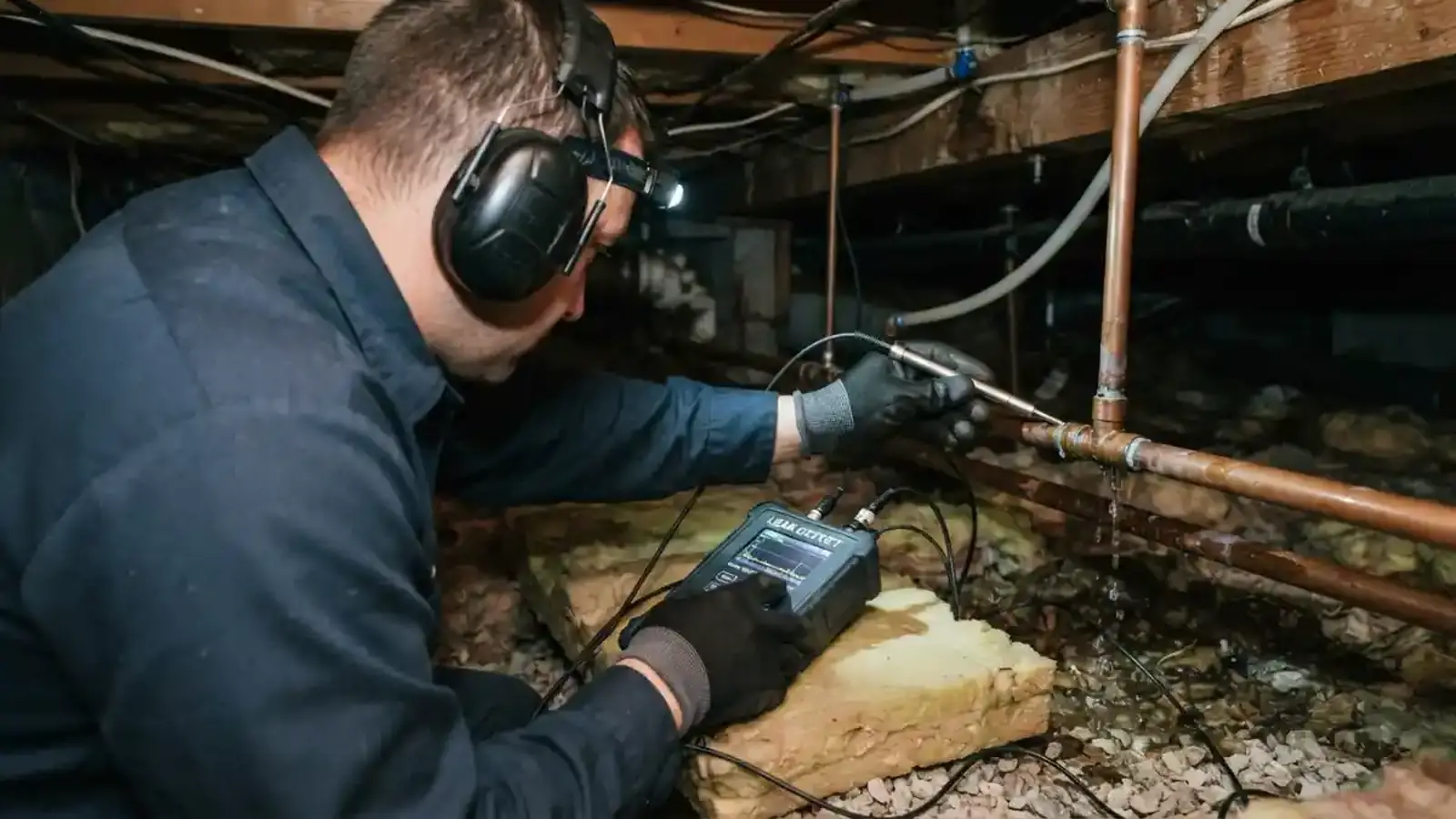
Finding the leak you cannot see
Emergency leak detection in Waterford, CT starts with a symptom, not a pipe. A water bill that jumped, a meter that spins with every tap off, a stain on a ceiling or a musty smell in a closet are all common ways a leak announces itself.
Our job is to trace the water to its source with minimal damage. That means listening equipment, thermal imaging and pressure testing, followed by a clear explanation of what was found and what repair is needed.
When a leak is an emergency
Water coming through a ceiling, spreading under a wall or running behind a finished surface needs fast action.
If your meter keeps moving
Turn off every tap and appliance, then check your water meter. If the dial or low-flow indicator keeps moving, water is going somewhere. That could be a leaking toilet flapper, a failed irrigation valve, a slab leak or a break in the service line.
Homes on public water have a meter, and the Waterford Utility Commission, handles the system. If the meter moves after you have shut the house valve, the leak is likely between the meter and the house, which is a water service line issue.
A sudden high bill from a hidden leak is common in older homes along Waterford's older roads and villages, such as Jordan and Quaker Hill, where supply lines may be galvanized or copper that has aged.
Suspect a hidden leak?
Call the 24/7 line and tell us what you are seeing. We will explain what we can do on the first visit. If the leak turns out to be a burst line, see burst pipe repair.
How we locate a hidden leak
We choose the method that suits the pipe and the building.
| Method | What it finds | Best use |
|---|---|---|
| Acoustic listening | Sound of water escaping under pressure | Pressurized lines in slabs and walls. |
| Thermal imaging | Temperature differences from moisture or hot water | Wet walls, ceilings and radiant leaks. |
| Pressure test | Whether a line holds pressure | Confirming a supply or drain line fault. |
| Camera inspection | Cracks and joints in drain lines | Drain and sewer leaks. |
Where leaks hide in Waterford homes
These are the places we check first.
- Under-house crawlspaces and basements near the main entry.
- Behind tubs and showers, where drain and supply lines meet.
- Ceilings below upstairs baths and kitchens.
- Water heater and boiler connections.
- Irrigation lines and outdoor spigots, especially after winter.
- Underground service lines between the meter and the house.
What changes the price
Leak detection pricing depends on the time and equipment needed.
- House size and the number of suspected areas.
- Whether the leak is in a slab, wall, ceiling or underground.
- Combined detection and repair in one visit.
- After-hours dispatch for an active leak.
- Whether a camera or pressure test is needed.
- Insurance note: many policies cover the damage from a sudden leak and sometimes the cost of finding it, but not the pipe repair. Ask your insurer.
Moisture is not always a leak
Condensation on cold pipes, a poorly vented bathroom and a window that does not shed water can all mimic a plumbing leak. Before we open anything, we check whether the moisture follows a pattern that matches those causes.
That step saves money. A thermal camera can show a cold, wet area, but only a pressure test or listening check confirms that water is escaping a pipe. We tell you honestly when a leak turns out to be something else.
Code and permit note
Finding a leak is diagnostic work, but fixing it may involve code. The 2021 International Plumbing Code (IPC), adopted by the Connecticut State Building Code, sets how pipes must be supported and protected, which matters when a repair opens a wall. Ask the town if a larger repair needs a permit.
Pool, spa, yard and meter box leaks
Not every leak is inside the house. A pool or spa that loses water faster than evaporation explains, a soft patch in the yard or a meter box that stays full of water can all point to a supply line problem outside the walls.
Start with the meter test, then tell us where you see the symptom. We track outdoor leaks by pressure testing and listening, which limits how much of the yard is dug up.
Water quality and your pipes
The City of New London Utilities annual report, which covers Waterford, notes phosphate added for corrosion control and lime added to adjust pH. Water chemistry cannot stop an old pipe from failing, though, and a pinhole leak often forms where a pipe has aged. If you see repeated pinholes, ask us about repiping.
Private well owners should test water annually per state health department guidance, since corrosive water can shorten pipe life.
Frequently asked questions
Yes. Active leaks are treated as emergencies, and the 24/7 line dispatches a plumber the same day when available.
Often yes. Acoustic and thermal tools let us narrow the location before any opening is made.
A running toilet, irrigation fault or underground line leak is the usual cause. We can check fixtures, then test the lines.
Coverage varies. The resulting damage may be covered while the pipe repair is not. Check your policy.
Yes. We explain the repair, quote it and fix it, or direct you to the right trade if it is outside plumbing.
Yes, including Niantic, East Lyme, New London and Montville.